
Always running out of time in your lessons? This is an issue that is extremely common for teachers, whether it’s visible from outside the classroom or not. It’s something I really struggled with when I first started teaching, but luckily someone taught me a little trick that I have been using ever since. We have so much to cover in a lesson and usually a very limited time to do it in, so how do we make it all fit?
When I have worked with teachers who struggle with timing, it is usually for one or more of the following reasons:
Trying to fit too much into a lesson.
Mismanaging how time is divided between activities in the lesson.
Allowing too much time for class discussion.
Stopping lessons to deal with behaviour issues.
There are many other reasons, and each of these reasons is a topic for a post in itself, however let’s deal with the first two points as those are the ones that teachers commonly face that relate to planning.
So Much Work, So Little Time
When we receive our framework at the beginning of the year, it is up to us to divide it across the weeks accordingly in our Long Term Plan. It is tempting just to divide the year up by topic evenly, however not all topics take the same amount of time to cover. For example, if you are teaching lower primary math, you will know that it takes longer to teach division than it does to teach addition, and so your year plan should reflect this. Take time to really look at what you are going to be teaching, and divide your weeks up accordingly. If it’s a subject and year group that you have taught before, draw on your prior experience to distribute the work. If this is your first year teaching a subject, ask a more experienced staff member to give insight into which topics take a long time. You cannot allocate the same time frame for each topic, because they are all different. The time to cover the curriculum is there, we just need to manage it properly.
Structure Your Lessons
A good lesson plan template will have a column in which you list how long each activity should take. This is essential in order to ensure you aren’t yelling the homework at students as they run down the hallway. Regardless of the amount of time you have been given for a lesson, the formula for dividing the time is usually the same. This is what, in my experience, always works:
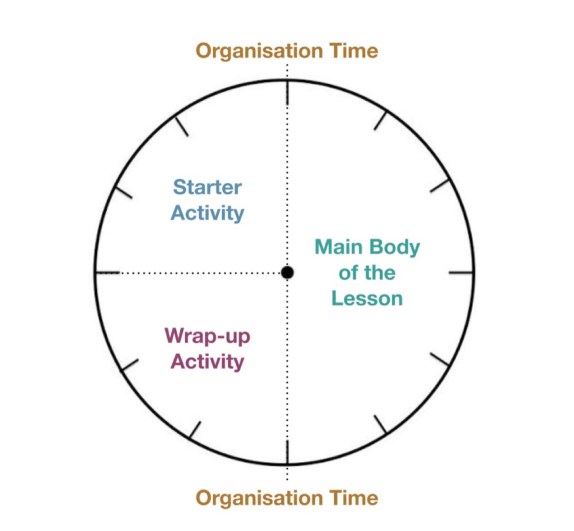
Subtract 10 minutes for ‘Organisation Time’. Regardless of how quickly you try to start a lesson, there will always be questions, stories and organisational
issues etc that take time to sort out. This happens both at the beginning and the end of the lesson, and so start by subtracting five minutes at the beginning and five at the end. The time at the end is for students to pack up and reorganise, and avoids ‘bell panic’. These five minutes at the beginning and end are also the times when you should be putting students in groups if you are planning on doing group work, and then moving them back afterwards.
Divide the rest of the lesson up into four parts. One part for a starter activity, two parts for the main body of the lesson, and one part for the wrap-up.
For example, if a lesson is 40 minutes long, it should look like this:
5 minutes – Organisation (Mess about time)
7 minutes – Starter Activity
14 minutes – Main Body of the Lesson
7 minutes – Wrap Up Activity
5 minutes – Organisation (Mess about time)
When teachers see this break down of the allocated time, the response is often that the time given for the main body simply isn’t enough, and if you were planning to do the whole topic in this time you would be right. However, our lesson starter isn’t a random activity, but something that adds to the topic. The same can be said for the wrap up activity. If you were teaching division, you wouldn’t just walk in and hand out the worksheets for students to complete, would you? No, you would introduce it properly. Look at the starter, main body and wrap up as being the lesson, not just the time allocated for the main body.
Sometimes, you may need to borrow minutes from the time you would normally allocate for each section of your lesson, and this is fine so long as you don’t get carried away. A few minutes here and there won’t make a big difference, so long as when you add up your ‘Timing’ column in your plan, it equals the amount of time you actually have to teach. Take a few minutes to do the math so you don’t regret it later.
Dividing your plan up really is as simple as that. Once you have it divided up and you have planned according to the time, the important thing is to stick to it. You should always have your lesson plan out on your desk to make sure you are on track, and even the most experienced teachers do this in order to ensure they are working to the timeline they have set themselves.
 Better Educate Than Never